



|
||||||
|
|
|
|
|
|
|
 |
||||||||||||||
 |
||||||||||||||
|
Text © Freddy Silva 1997. Photos © Freddy Silva, Colin Andrews, Steve Alexander
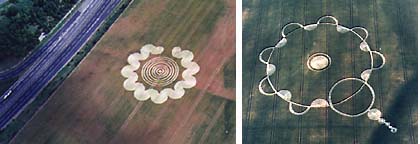
The elegance and precision in the patterns of 1995 more than compensated for the fact that formations had decreased in number for the first time in the history of the phenomenon. Just as previous years had seen a theme in designs, so 1995 appeared to follow a particular focus. This was the year when the Circlemakers showed a preoccupation with atoms, magnetic fields and solar systems. Four formations across Hampshire began with a simple circle surrounded by a string of beads, only to be followed by a more stylized version which appeared to show actual, off-centered orbits where the paths laid by the downed wheat was no more than 5 inches wide. This was superceded at Ropley by the most complex design to date, comprising 98 circles, varying in width from 1-15 ft, arranged in a seemingly random circular pattern within which was again laid a depiction of planets in orbit around a central sun. Again the orbit rings, barely discernible in the above shots, were thin bands of gently and precisely laid barley, a brittle and most unusual plant to use for such precision. But the true star of the year was a recognizable 240-ft wide depiction of the inner solar system which was to keep mathematicians and astronomers busy for some years. The planets and the sun were placed with exact orbital ratios using thin bands of upright crop. The sphere sizes themselves were also depicted with amazing life-likeness, albeit in smaller scale. All except the Earth which was missing. Prof. Gerald Hawkins was later to work out that the whole design contained significant mathematical equations pertaining to diatonic ratios, eventually to find that by focusing on Mars a certain date was being given. His idea was that the Circlemakers had taken Earth out of the equation to tell us that they knew where we were, and wished us to focus on some other planet. He looked at the primary planetary positions over a hundred year period and found three best fits. The first was November 1903, when the Wright Brothers discovered a plane could fly; the next was July 11, 1971, when Mariner 9, the first space probe to orbit Mars, was on its way to said planet. A coincidence? Perhaps not. The difference between the two occurrences was 67 years which coincided with the number of 'asteroids' orbiting the design. |
||||||||||||||
 |
||||||||||||||
 |
 |
 |
||||||||||||
 |
||||||||||||||
 |
|||||||
|
|
|
|
|
|
||
|
|||||||